The phone call ended two minutes and sixteen seconds before the collision. By then, according to federal safety investigators, the Houston pilot directing the bulk carrier Yangze 7 had spent 39 minutes and five seconds on a personal call with another pilot who was directing another vessel.
The Yangze 7 and the towboat Miss Peggy collided on July 19, 2024, near Lynchburg, Texas, while both vessels traveled inbound on the Houston Ship Channel. The towboat capsized and sank. Four crew members survived. One died. Federal prosecutors have since announced a seaman’s manslaughter charge against Houston pilot Darris Ornel Jefferson. NTSB investigation · U.S. Attorney’s Office announcement
The call matters. But its duration alone doesn’t tell you what either bridge team could see, what anyone said over the radio, or whether someone still had time to act. That’s where the records have to do the work.
What investigators found on the Houston Ship Channel
The National Transportation Safety Board’s report puts the call’s start at 1:22:39 p.m., local time. The call ended at 2:01:44 p.m. The collision occurred at about 2:04 p.m. The other pilot was directing an outbound tanker. This wasn’t a call between the Yangze 7 and the Miss Peggy to coordinate how they would pass.
The NTSB found that the call distracted the Yangze 7 pilot. It attributed the collision to a loss of awareness by the pilot, the bulk carrier’s bridge team and the towboat’s captain when they failed to keep a proper lookout. The towboat captain did not detect the bulk carrier approaching from astern, and the bulk carrier’s bridge team did not detect the towboat until it was less than a ship’s length ahead. Investigators did not treat the call as the sole explanation.
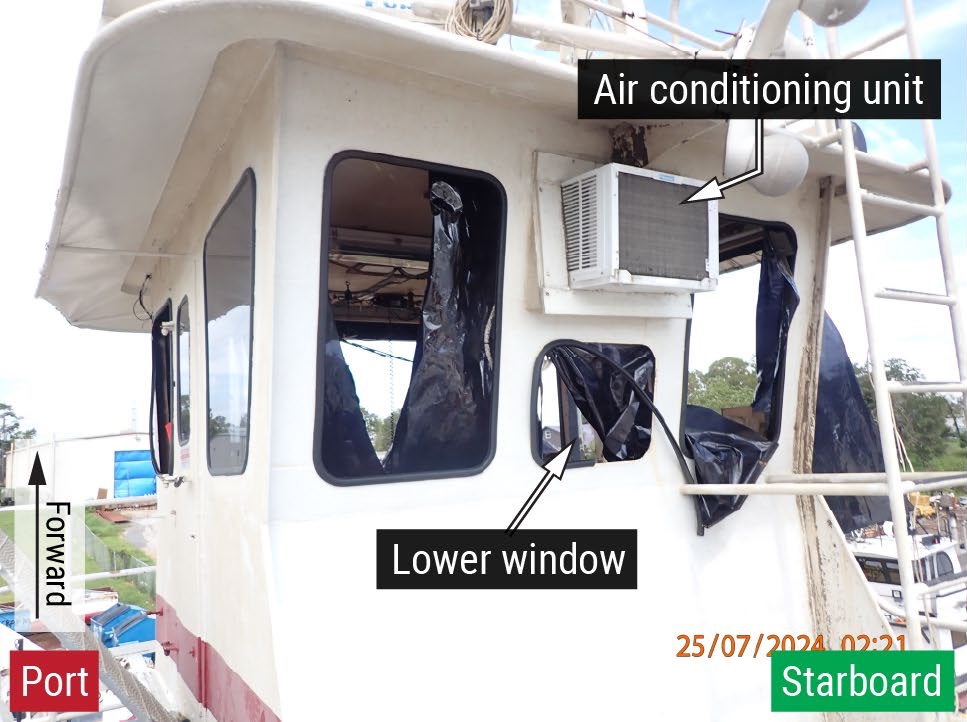
U.S. Coast Guard photograph, reproduced in NTSB report MIR-26-24, Figure 18.
What the government must prove, and what a civil case asks
The U.S. Attorney’s Office announced on November 18, 2026, that a grand jury had indicted Jefferson. Prosecutors allege that his misconduct, negligence and inattention while piloting the Yangze 7 caused a death aboard the Miss Peggy. The federal seaman’s manslaughter statute, 18 U.S.C. § 1115, covers specified vessel personnel whose misconduct, negligence or inattention causes a death. To obtain a conviction, prosecutors must prove every element beyond a reasonable doubt. An indictment states allegations. It does not prove them, and Jefferson has the presumption of innocence.
A civil wrongful-death case asks a different set of questions: Who owed the mariner a duty? What did that person or company do or fail to do? Did that conduct cause the death under the law that governs the claim? What losses can the law compensate? Civil plaintiffs generally face a preponderance-of-the-evidence standard rather than the criminal standard, though the particular claim determines the applicable rules. The Jones Act, for example, lets a qualifying seaman’s personal representative bring a negligence claim against the employer if an on-the-job injury causes the seaman’s death. Claims against someone other than the employer require a separate legal analysis. The criminal charge does not decide any of those issues, and a family does not need a conviction to pursue a viable civil claim.
How the evidence comes into a civil case
After a collision, I want to find out who controls the original recordings and data before anyone overwrites them. I want the best available copy from the source, with the timestamps and enough information to check what the recorder actually captured.
- Phone records can establish when a call started and stopped, and they can help identify the other line. Ordinary billing records do not tell you what the two people said or where each person was looking.
- Voyage data recorder files and bridge audio can help show what people on the bridge said, which orders they gave and when they gave them. The recorder only tells you what its equipment captured.
- Vessel tracking, radar data and radio traffic can help reconstruct how the vessels approached each other, what each watch team communicated and when the danger would have become apparent. Before comparing any of those records, check whether their clocks agree.
- Watch assignments, standing orders and crew testimony can tell you who had which job and what people could see from their stations. A written procedure tells you what should happen. It does not establish what actually happened.
The NTSB’s public investigation docket shows why that last distinction matters. It inventories different records, including a voyage-data-recorder specialist’s factual report and crew interviews. Congress bars the use of the Board’s accident investigation report in a civil damages action arising from the matter. That doesn’t make every underlying record off-limits or automatically admissible. In federal civil court, parties can request properly scoped records from other parties under Rule 34 and subpoena qualifying records from nonparties under Rule 45, subject to Rule 26 and other limits. Before a judge or jury can rely on a record, the parties still have to address authentication and any other rules of evidence that apply. 49 U.S.C. § 1154(b) · Federal Rules of Civil Procedure
What I look for when I represent captains and crews
I represented a tugboat captain who fell on ice-covered stairs in Port Arthur. I inspected the tug and developed testimony that the same hazard had already stopped a job that morning. I also represented a deckhand whom a steel hatch struck aboard a Weeks Marine tug on the Houston Ship Channel. Both cases resolved in confidential settlements. Those cases involved different hazards. They illustrate a question I bring to maritime cases: What did the people responsible for the work have a chance to see and do before someone got hurt?
Here, the 39 minutes give investigators a fixed point in the timeline. The harder and more useful question is what happened around that point, on both vessels. The phone call belongs in the story. So do the people who stood watch, the equipment they relied on and the warnings that did or did not reach them.
Related: Houston maritime injury claims · Jones Act claims for vessel crews · Maritime injury and wrongful death