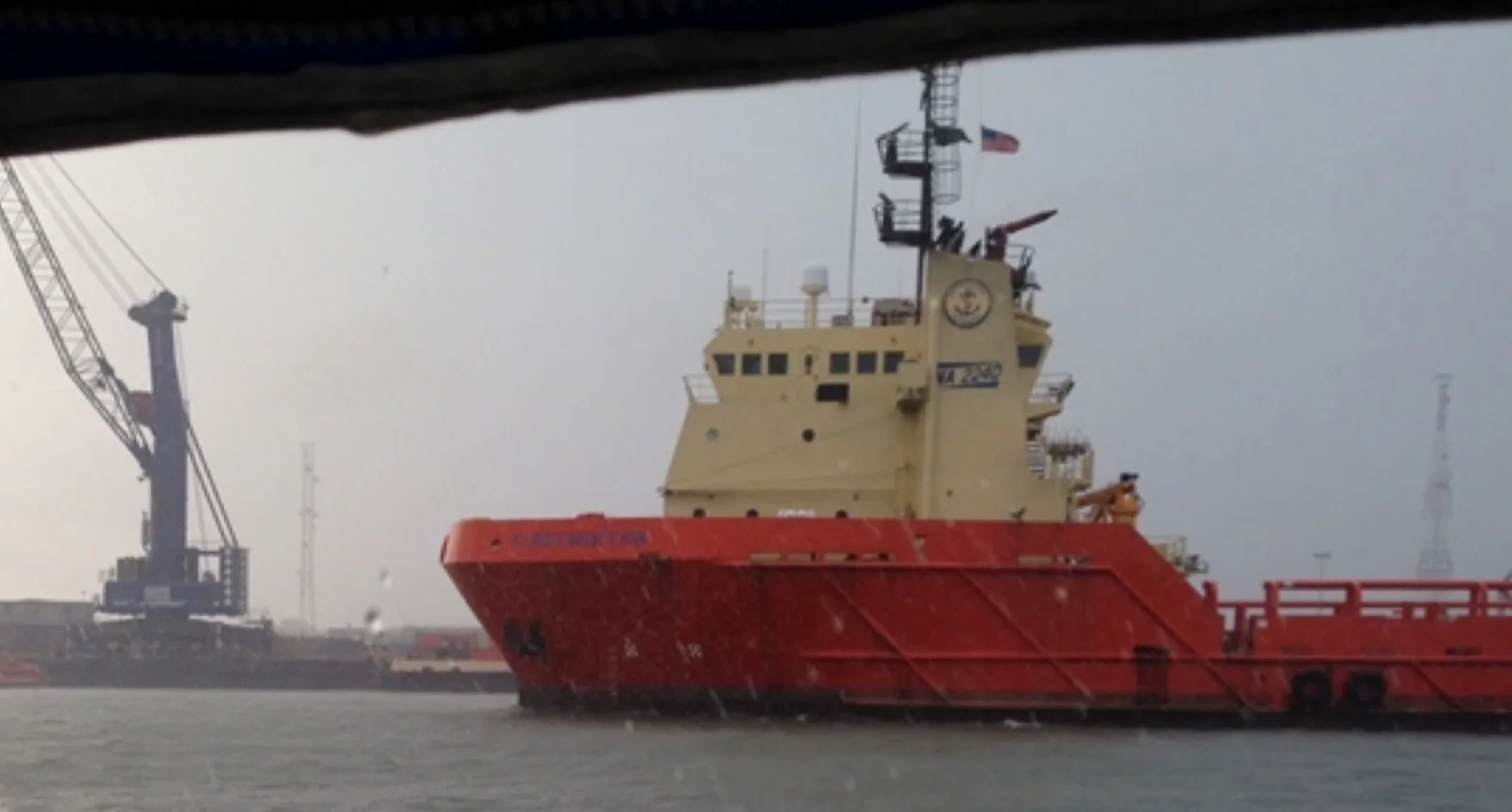
Where Houston Mariners Get Hurt
The Port of Houston is not one place. It is a chain of facilities strung along Buffalo Bayou and the upper bay: the Turning Basin general cargo terminal, Care and Jacintoport, Woodhouse, the Barbours Cut Container Terminal at Morgan's Point, which opened in 1977, and the newer Bayport Container Terminal down the La Porte shoreline. Between the public terminals sit dozens of private chemical, grain, and liquid-cargo docks, and between all of them runs a constant stream of tugs, tank barges, crew boats, line-handling launches, and bunker barges.
Each of those workplaces produces its own injuries. Tankermen get hurt making and breaking cargo hoses on barges rafted three deep at fleeting areas along the San Jacinto River. Deckhands go down on wet gunwales building tow in the dark, or get caught in face wires and winches. Ship-assist tug crews work under the flare of a moving ship's bow, where a parted line can take off a limb. Dredge crews, who have been working the channel steadily through the Project 11 expansion that widened the Galveston Bay reach to 700 feet, deal with heavy pipe, anchor barges, and machinery that runs around the clock. Add nighttime traffic on Buffalo Bayou, fog seasons on the upper bay, and companies running short-handed crews on long hitches, and you have a waterway that sends workers to Houston emergency rooms every week.
The Law That Protects You Is Federal, and It Is Old
If you work as a crewmember of a vessel, your rights do not come from Texas workers' compensation. They come from federal maritime law, and they are considerably stronger.
The Jones Act, 46 U.S.C. § 30104, gives a seaman the right to sue his or her employer for negligence. The standard of causation is famously light: if the employer's negligence played any part, even the slightest, in causing the injury, the employer is liable. Negligence can mean an undermanned tow, a missing non-skid surface, a broken winch the company knew about, or an order to work in weather no prudent captain would work in.
Unseaworthiness is a separate claim against the vessel's owner. The owner owes an absolute duty to provide a vessel reasonably fit for its intended purpose, including its gear, its lines, and its crew. If a defective wire, an inadequate crew, or a poorly maintained deck contributed to your injury, the owner is liable even without proof of negligence.
Maintenance and cure is the oldest of the three. From the moment a seaman is injured or falls ill in the service of the vessel, the employer owes daily living expenses (maintenance) and medical care (cure) until the seaman reaches maximum medical improvement. It is owed regardless of fault, and courts resolve doubts in the seaman's favor. Employers that cut off maintenance and cure without a good reason can be liable for additional damages and attorney's fees.
Who counts as a seaman? Under Chandris, Inc. v. Latsis, the Supreme Court's test, you need a connection to a vessel in navigation, or an identifiable fleet of vessels, that is substantial in both duration and nature. As a rule of thumb, spending roughly 30% or more of your working time in the service of a vessel qualifies. Most tug, barge, dredge, crew boat, and ship crews on the Houston Ship Channel meet the test.
When a mariner is killed, the family's claims arise under the Jones Act's wrongful death provisions and, for deaths on the high seas beyond three nautical miles, under the Death on the High Seas Act (DOHSA). These cases have their own rules about who may recover and what damages are available, and they reward early, careful investigation.
Cases This Firm Has Actually Handled
In 2009, Somali pirates hijacked the Maersk Alabama, the ship the world later knew from the film Captain Phillips. VB Attorneys represented 9 crewmembers of the Maersk Alabama against Maersk and won confidential recoveries for each one. It was one of the most complex maritime and Jones Act cases in history, and it changed the safety and security of mariners.
Closer to the day-to-day work of the channel: Brian Beckcom served as lead counsel for a relief captain who was injured at sea and then denied prompt medical care by his employer. The case ended in a $10 Million Jones Act Result. The pattern in that case, a company treating a serious injury as an inconvenience to the schedule, is one Houston mariners will recognize.
How We Prepare Your Case
1. Your lawyer leads your case.
The lawyer you hire is the lawyer who leads your case, an experienced trial lawyer, supported by a Board Certified partner, and you can talk to your lawyer directly. Not a case manager.
2. We find the evidence.
Maritime cases are won with records, and records disappear. We move early to secure vessel logs, rough logs, and bell books; ECDIS and VDR (voyage data recorder) data; Coast Guard Form 2692 marine casualty reports; maintenance and repair records for winches, wires, and deck gear; crewing records, work schedules, and hours-of-rest documentation.
3. We build it for court.
We prepare every case as if it will be decided by a jury, with marine safety experts, medical proof, and a full damages workup. That preparation is why any settlement offer we bring you is a serious one.
4. You decide.
We advise. You alone decide whether to accept a settlement or go to trial.
A typical maritime injury case takes one to two years. Contact VB Attorneys today if you want an honest assessment of where yours would land.
Where Houston Maritime Cases Are Filed
Most Houston Ship Channel cases belong in the Houston Division of the United States District Court for the Southern District of Texas, at the federal courthouse downtown. Injuries on the lower bay can fall in the court's Galveston Division. Because federal law preserves a seaman's right to bring Jones Act and general maritime claims in state court as well, under the saving-to-suitors clause of 28 U.S.C. § 1333, many cases are filed in the Harris County district courts. Choosing between them is a strategic decision that depends on the defendant, the judge, and the facts.