Houston Construction Accident Lawyers
A construction injury can leave a worker facing surgery while several companies argue about who controlled the job. The employer, general contractor, property owner and equipment company may each have different responsibilities. Finding the right claim starts with finding out what each company actually did.
Brian Beckcom and Vuk Vujasinovic represent people with serious injuries and families whose loved ones died at work. Their construction and industrial cases have involved missing guardrails, roof failures, disputed control over lifting operations and fatal crane work. Both are Board Certified in Personal Injury Trial Law by the Texas Board of Legal Specialization.
Tell Us What Happened 877-724-7800
Free consultation. No attorney’s fee unless we recover compensation for you.
A construction accident is not automatically only a workers’ compensation claim
The first questions are who employed you, whether your work was covered by Texas workers’ compensation, and whether another company contributed to the injury. A company’s name on the project sign does not answer those questions. Contracts, insurance arrangements and actual jobsite conduct matter.
If your employer carried workers’ compensation
For a covered work injury, workers’ compensation generally replaces an ordinary negligence lawsuit against the employer. Texas Labor Code § 408.001 contains a narrow fatal-injury provision allowing exemplary damages for specified survivors when the employer’s intentional conduct or gross negligence caused the death. That is not a general exception for every serious injury. Read § 408.001.
If your employer did not carry workers’ compensation
Many Texas private employers can choose not to subscribe. In an eligible nonsubscriber case, the injured employee still must prove employer negligence caused the injury. Under Labor Code § 406.033, the employer cannot use certain defenses, including the employee’s contributory negligence, assumption of risk or a fellow employee’s negligence. An occupational accident policy is not necessarily Texas workers’ compensation. We examine the actual coverage rather than relying on the label. Read Chapter 406.
If another company caused or contributed to the accident
A covered worker may also have a claim against a legally responsible third party. Examples can include a separate subcontractor, equipment manufacturer or vehicle operator. Workers’ compensation reimbursement rights must be addressed if both benefits and a third-party recovery are involved. Labor Code Chapter 417 governs that interaction. Owner-controlled and contractor-controlled insurance programs can complicate who qualifies as an employer protected by the exclusive-remedy rule. We check the project’s insurance arrangements before treating another contractor as an available defendant.
Who can be responsible for a Houston construction injury?
Responsibility follows the facts and applicable law, not simply a company’s title. Brian and the VB Attorneys team investigate the work assignment, contracts, equipment and decisions that put the worker in danger.
- General contractors and subcontractors: Did the company control the work that produced the injury, perform the dangerous activity, or undertake a relevant safety responsibility? A broad right to inspect a project does not automatically establish control over the particular work.
- Property owners: Was there a dangerous property condition, what did the owner know, and does Chapter 95 apply? Ownership alone does not establish liability.
- Crane, rigging and equipment companies: Who selected the lifting method, inspected the equipment, directed the operator and controlled the load path?
- Product manufacturers: Did a defect in a machine, component or warning cause the injury? Product claims require evidence beyond the fact that equipment malfunctioned; the product and its condition must be preserved for a fair inspection.
- Drivers and other third parties: A delivery truck, backing vehicle or other separate operation may create a claim independent of the injured worker’s employer.
Some cases involve negligent activity; others involve a condition of the premises. Those are not interchangeable labels. For example, the proof needed for an actively mishandled load may differ from the proof needed for an unguarded opening. We identify the legal theory that matches the evidence instead of assuming every company on the site owes the same duty.
The Texas Supreme Court’s JLB Builders, L.L.C. v. Hernandez decision explains why actual or contractual control over the injury-producing work matters in claims against a general contractor. For a product design-defect claim, CPRC § 82.005 requires proof of a safer alternative design and producing cause, among the claim’s requirements. Naming every company without that analysis does not build a stronger case.
Chapter 95 can decide whether a claim against the owner survives
Texas Civil Practice and Remedies Code Chapter 95 can impose demanding requirements on claims against commercial property owners by contractors and their employees. The threshold issue includes whether the injury arose from the condition or use of the improvement the contractor was constructing, repairing, renovating or modifying. When § 95.003 applies, the claimant must establish both qualifying control over how the work was performed and the owner’s actual knowledge of the danger coupled with an inadequate warning. A mere right to start or stop work, inspect progress or receive reports is not enough. Read Chapter 95.
That makes the details important: who gave the instruction, what work the instruction concerned, who knew about the specific hazard and what warning reached the worker. A general safety manual is not a substitute for proving the required facts.
A defect that existed before the contractor arrived does not automatically take a case outside Chapter 95. The relationship between the hazard and the improvement matters. In Los Compadres Pescadores, L.L.C. v. Valdez, the Texas Supreme Court applied Chapter 95 but upheld the workers’ claims on the evidence presented. The statute is a serious hurdle, not an automatic win for either side.
In Mark B.’s roof-collapse case, Brian challenged the owner’s Chapter 95 defense by distinguishing Mark’s tree-trimming assignment from the roof defect that caused his fall. The case settled for $1 million. That case illustrates the value of examining the actual assignment; it does not establish a blanket exception for pre-existing defects.
Falls, cranes, trenches and other construction hazards
Construction cases can involve falls from roofs, scaffolds and ladders; missing balcony rails; struck-by and caught-between injuries; suspended loads; trench collapses; electrocution; defective tools; and fires or explosions. The right investigation depends on the mechanism. A roof-fall case may require examining the structure and fall-protection arrangements. A lifting case may depend on load calculations, rigging, operator communications and the sequence of commands.
Federal construction safety rules provide concrete points to investigate. For example, 29 C.F.R. § 1926.501 addresses fall protection, with different provisions for different work and hazards. 29 C.F.R. § 1926.651 addresses excavation precautions, including access, nearby utilities and inspections. The applicable rule must be matched to the actual operation; one height threshold does not govern every construction task.
Section 1926.501(b)(1), for example, requires specified fall protection at unprotected sides or edges six feet or more above a lower level in the circumstances it covers. Section 1926.651(c)(2) requires a safe means of exit in trenches four feet or deeper, positioned so workers travel no more than 25 feet laterally. These are examples, not a complete safety checklist.
An OSHA investigation and a civil injury lawsuit serve different purposes. An OSHA citation does not automatically prove civil liability, and the absence of a citation does not decide whether a person has a valid claim. We examine the applicable duty, causation, evidence and legal defenses independently. OSHA records can identify leads, but they do not replace a case-specific investigation.
Construction and industrial cases our lawyers have handled
$44,370,000 jury verdict in the Barron refinery crane case
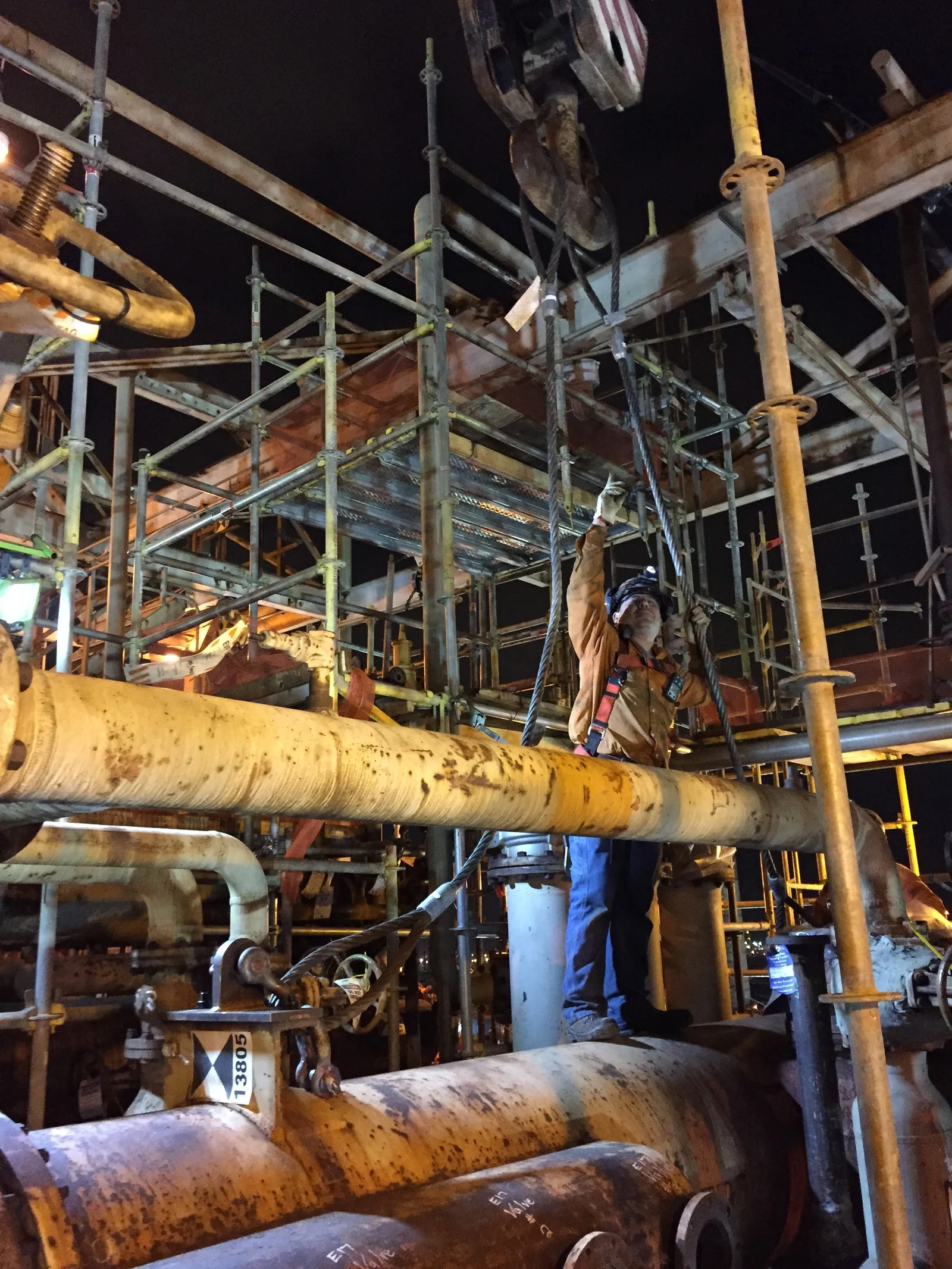
Vuk led the trial after a rigger died during work at ExxonMobil’s Beaumont refinery. The jury assessed $44,370,000 in damages and allocated responsibility among B&G Crane Service, ExxonMobil and AltairStrickland. The trial proceeded against B&G; the other defendants had settled earlier. B&G later settled too, as the Ninth Court of Appeals recorded in 2022. The verdict and later settlement are distinct outcomes. Read the refinery crane case.
$17,720,000 ironworker verdict and the later appellate ruling
Vuk represented the family in the Suarez ironworker wrongful-death case, which produced a $17,720,000 jury verdict. On May 3, 2018, the First Court of Appeals reversed the judgment and rendered a take-nothing judgment against Austin Bridge & Road based on workers’ compensation exclusive remedy. Read the appellate opinion. The case shows why project-wide insurance arrangements must be investigated alongside the accident itself.
A fall, disputed site control and a confidential settlement
In James T.’s case, a construction supervisor suffered orthopedic and brain injuries during a lifting operation. Brian investigated the owner’s involvement and challenged its Chapter 95 defense. The case resolved through a confidential settlement.
$650,000 settlement after a home inspector’s fall
Jason M. fell when a ladder shifted beside a balcony without guardrails. Brian developed testimony about advance knowledge of the missing protection. The case settled for $650,000, including a medical trust.
Every case is different. Prior results do not guarantee a similar outcome.
When a construction accident causes a death
Families need answers about what happened and who can pursue a claim. Under Texas law, a wrongful-death claim generally belongs to the deceased person’s surviving spouse, children and parents. A sibling does not qualify solely because of that relationship. A survival claim is different: it preserves the claim the deceased person could have brought, and it is pursued on behalf of the estate by a legally authorized person. Chapter 71 sets out these separate claims.
The evidence can include lost financial support, lost companionship and other legally recoverable family losses. An estate claim may include the person’s conscious pain and medical expenses before death, if supported. Which damages are available depends on the claim and proof; they are not automatically payable in every fatal accident. Workers’ compensation coverage and statutory employer issues can also affect a fatal construction case.
We examine the fatal incident and the family’s legal position together, including who can act for the estate and whether related claims must be coordinated. See our wrongful-death practice and explanation of survival claims versus wrongful-death claims.
Proving the injury’s effect on the rest of your life
A hospital bill does not describe the full effect of a spinal injury, amputation or brain injury. We investigate the treatment already provided and the future care supported by the medical evidence. That can include rehabilitation, assistive devices, help at home and changes to the work a person can safely perform. We do not assume that every operation ends the medical consequences or that every worker can return to the same physical job.
In a qualifying civil claim, compensation can include medical expenses, lost earnings and earning capacity, pain, mental anguish, physical impairment and disfigurement, depending on the evidence and law. Workers’ compensation benefits follow a different system. The available insurance, responsibility findings and applicable defenses also affect what can be recovered.
When Texas proportionate-responsibility rules apply, a claimant generally cannot recover if more than 50% responsible, and a lesser percentage reduces damages. That rule is not a substitute for the separate rules governing nonsubscriber or other special claims. Read Chapter 33. We investigate accusations against the worker instead of accepting them as the last word.
Explore related help for personal injury claims, amputation and crush injuries, traumatic brain injuries, spinal cord injuries and industrial explosions.
What to do after a construction injury
- Get medical help and leave immediate hazards to emergency responders. Do not enter an unsafe site to collect evidence.
- Report the injury promptly. Identify when, where and how it happened as accurately as you can. Keep a copy of the report if available.
- Preserve what you already have. Keep photographs, messages, work assignments, pay records and names of witnesses. Preserve originals; do not alter or delete material.
- Identify the companies involved. Record the employer, site location, equipment owner and other contractors if known. Do not guess if you do not know.
- Get advice before signing a release. A settlement or other document may affect more than one claim. A lawyer can assess preservation needs and request the relevant records through proper channels.
Texas personal-injury and wrongful-death claims often have a two-year limitations period, but accrual, exceptions, notice requirements and other claim-specific rules matter. Workers’ compensation has separate reporting and filing requirements. Do not use a general website deadline as your filing calendar. Read CPRC § 16.003.
Questions about construction accident claims
Can I sue if I was a subcontractor’s employee?
Possibly. Your employer’s coverage, the project’s insurance arrangements, the defendant’s duties and the evidence of fault determine the available claims. Being employed by a subcontractor neither guarantees nor rules out a lawsuit against another company.
Does an OSHA violation mean I automatically win?
No. You still need a legally valid claim and proof connecting the defendant’s conduct to the injury. The relevance and admissibility of a safety finding depend on the case.
What if the company says the accident was my fault?
That is an allegation to investigate. Photographs, witness testimony, instructions and equipment evidence can test it. Different fault rules can apply to different claims.
Can a family bring a case after a fatal accident?
Qualified survivors may have a wrongful-death claim, and an authorized estate representative may have a survival claim. Employer coverage and other defenses must also be evaluated.
What if I worked on a barge or a marine construction project?
Do not assume an ordinary land-based construction analysis controls. The vessel, your duties and where the work occurred can raise maritime questions. Start with our maritime injury practice so the correct legal framework is considered.
How much does it cost to talk with VB Attorneys?
The initial consultation is free. If we accept the case, the representation agreement explains the fee and expenses. You pay no attorney’s fee unless we recover compensation for you.
Tell Us What Happened
You do not need to know which company is legally responsible before you call. Tell us the jobsite, the work you were doing and what changed your life. Brian and Vuk can evaluate whether the facts support a claim and what needs to be investigated next.
Request a Free Consultation 877-724-7800
VB Attorneys · 1220 Augusta Drive, Suite 240, Houston, TX 77057