News & Insights · Maritime safety
A dangerous atmosphere can turn a routine shipboard job into a fatal emergency. The investigation must reach beyond the entry permit to the decisions that put people at risk.
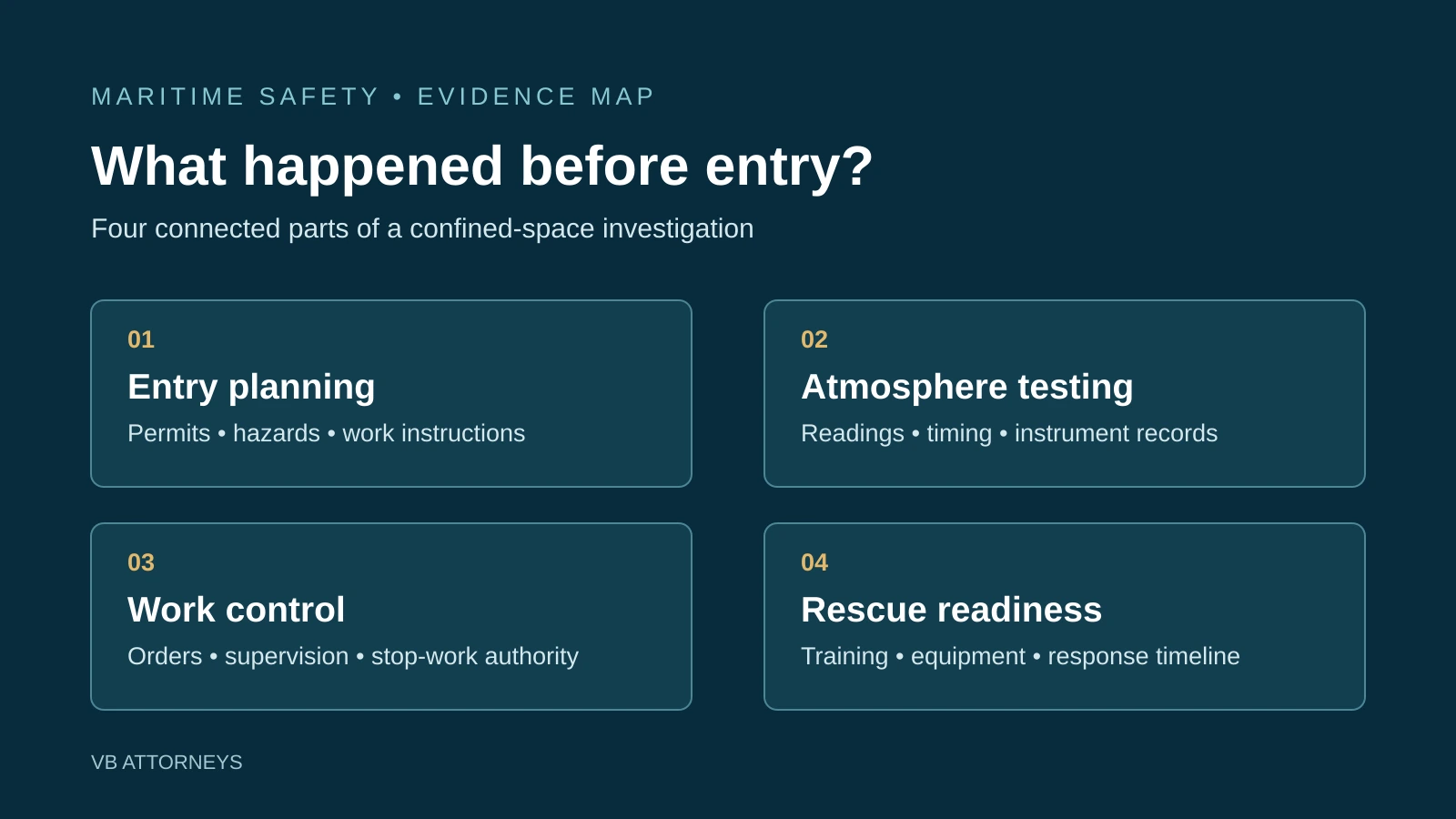
A crew member enters a tank, cargo space or another compartment to do a job. The questions that matter begin before that entry: Who identified the hazards? Who tested the atmosphere? Who authorized the work? And was a trained rescue team ready if something went wrong?
Those questions have renewed urgency. On October 20, 2026, gCaptain reported InterManager’s call to rethink enclosed-space safety, citing 354 recorded accidents from 1996 through 2026. InterManager’s own October 22 summary describes the same long-term record and findings from a survey of more than 900 seafarers.
For an injured seaman or a family facing a death at sea, the practical issue is whether the employer and vessel interests provided a safe way to perform the work. Brian Beckcom investigates maritime cases by connecting what happened aboard the vessel with the company decisions and records behind it.
What the 354 recorded accidents tell us
The figure covers roughly three decades. It is a count of recorded accidents, not a count of deaths and not a one-year accident total. InterManager maintains separate accident and fatality charts in its October 2026 statistical review.
The industry warning deserves attention, but it does not decide a particular lawsuit. A lawyer still must establish the applicable duty, what the defendant did or failed to do, and how that conduct or vessel condition caused the injury. Whether a particular operator received an earlier warning, recognized the same hazard or changed its procedures requires evidence. A later publication cannot simply be treated as a warning the operator possessed before an earlier accident.
Why a familiar shipboard space can be dangerous
Cargo holds, tanks, pump rooms and similar spaces can contain too little oxygen, toxic substances or a flammable atmosphere. Access and escape can be difficult. Opening a hatch does not establish that a space is safe.
The International Maritime Organization’s revised enclosed-space recommendations, adopted June 27, 2025, address risk assessment, ship-specific enclosed-space registers, atmosphere testing, training and rescue planning. They recommend against single-person entry. Their legal significance depends on the vessel, governing law and circumstances.
If someone collapses inside a space, another unprotected person entering can compound the emergency. Raise the alarm and activate trained emergency responders rather than attempting an untrained entry rescue.
Which safety rules apply?
SOLAS requires drills on covered vessels
For vessels subject to the relevant SOLAS requirements, crew members assigned enclosed-space entry or rescue responsibilities must participate in an enclosed-space entry and rescue drill at least once every two months. The rule addresses more than a signed attendance sheet: the drill provisions cover protective equipment, communications, atmosphere-testing instruments, rescue procedures and first aid. See SOLAS regulations III/19.3.3 and III/19.3.6, adopted through Resolution MSC.350(92).
Applicability must be checked against the vessel’s flag, type, service and governing requirements. The Coast Guard’s March 7, 2016 bulletin discusses enclosed-space drills and safety-management responsibilities.
Shipyard work has specific OSHA requirements
In shipyard employment, 29 C.F.R. § 1915.12 addresses precautions before entry into confined and enclosed spaces and other dangerous atmospheres. It specifies testing for oxygen, flammability and toxicity in that order, along with applicable training and rescue requirements. Where multiple employers’ workers may enter the same spaces, the regulation requires exchange of information about hazards, safety rules and emergency procedures.
The worker’s job and setting matter. An investigator must determine the applicable regulatory framework rather than treating shipyard rules, general-industry rules and shipboard international standards as interchangeable.
The evidence that can reveal what went wrong
A useful investigation builds a timeline from planning through the emergency response. The following records can help test competing accounts; their relevance depends on the particular operation.
- The entry plan: the permit, risk assessment, job instructions, space register, vessel drawings and names of the people who approved the work.
- The actual atmosphere: original gas-detector readings and downloads, calibration and maintenance records, testing times, sampling locations and the substances the instrument could detect.
- The condition of the space: cargo and cleaning information, ventilation arrangements, isolation records, connected compartments and changes during the job.
- The people and resources available: crew assignments, contractor roles, training, drill records, communications and the equipment available for the task.
- Control of the operation: who ordered entry, directed the work, supplied equipment, controlled ventilation and had authority to stop the job.
- Earlier warnings: relevant near-miss reports, audits, defect reports and safety communications, together with evidence of when the responsible people received them.
- The rescue and medical response: alarm times, radio traffic, rescue arrangements, evacuation decisions and medical records.
For example, a completed permit may say that testing occurred. Instrument data, timestamps and witness testimony can help establish what testing actually took place and whether conditions changed afterward. A company may have a written rescue procedure; equipment records and drill evidence can help show whether the people on that vessel could carry it out.
What rights does an injured seaman have?
A Jones Act claim against the employer
The Jones Act, 46 U.S.C. § 30104, permits a qualifying seaman injured in the course of employment to bring a negligence action against the employer. In an enclosed-space case, the investigation may concern unsafe instructions, inadequate preparation or an unreasonable emergency response.
Jones Act seaman status depends on the worker’s duties and substantial connection to a vessel or fleet. The Fifth Circuit’s en banc decision in Sanchez v. Smart Fabricators of Texas explains why the nature of that connection matters as well as its duration. Our Jones Act claims page explains this area in more detail.
Unseaworthiness is a separate question
A qualifying seaman may also have an unseaworthiness claim against the responsible vessel owner. The question concerns whether the vessel, equipment or crew was reasonably fit for its intended service. The Supreme Court’s decision in Mitchell v. Trawler Racer distinguishes that duty from negligence. It does not make the owner an insurer against every shipboard accident.
An unsafe atmosphere, unsuitable equipment or an inadequate crew may require investigation under this doctrine.
Maintenance and cure can matter immediately
A seaman injured or becoming ill in the service of the ship may also be entitled to maintenance and cure, covering qualifying living and medical needs. This obligation is distinct from proving a negligence case. Vaughan v. Atkinson discusses the shipowner’s maintenance-and-cure obligation. Eligibility, payment disputes and the scope of benefits require individual review.
What if the injured person worked for a shoreside contractor?
A qualifying longshore or harbor worker may fall under a different system. Section 905(b) of the Longshore and Harbor Workers’ Compensation Act allows certain vessel-negligence claims; it does not provide the seaman’s unseaworthiness remedy. Employer immunity and statutory limitations also matter.
Under Scindia Steam Navigation v. De Los Santos, vessel duties can involve the condition at turnover, areas or activities under the vessel’s active control, and a limited duty to intervene in specified circumstances. Ordinarily, the vessel can rely on an independent contractor to carry out its work safely, subject to these duties.
When several companies are involved, contracts and actual supervision help identify the responsible roles. Borrowed-employee status can also affect employer immunity; it is not automatically an additional route to recovery. W&T Offshore v. Fredieu illustrates the fact-sensitive inquiry. Worker status, control and the particular defendant’s duty must be evaluated together.
Our maritime work examines the decisions behind the injury
Brian’s maritime cases have required investigation of company safety systems and emergency decisions. In the $10 million Jones Act recovery for an injured towboat captain, the case examined food-safety failures and the response to the captain’s life-threatening illness.
Brian also represented nine Maersk Alabama crew members, examining warnings, routing and security decisions and obtaining confidential settlements. That work reflects the importance of examining what company decision-makers knew and what they did with that information.
Each case turns on its own facts. Past results do not guarantee a similar outcome.
What should a family preserve after an enclosed-space accident?
Keep documents already lawfully in your possession: employment information, medical records, messages, photographs and the names of witnesses. Save original files and their dates. Write down what you personally remember, distinguishing it from what someone else told you.
Do not enter a dangerous space, alter equipment or access company systems without permission to gather evidence. A lawyer can evaluate appropriate preservation demands and legal procedures for obtaining vessel and company records.
Common questions
Does an industry safety warning prove my case?
No. It may help identify an issue worth investigating. The case still requires evidence connecting a legally responsible party’s conduct or vessel condition to the injury. Timing, relevance and the rules governing use of the document matter.
Can a signed entry permit end the investigation?
A permit is one piece of evidence. Testing records, work conditions, witness accounts and the rescue timeline may support or contradict what it says.
Can the same accident involve more than one company?
Yes, but company involvement alone does not establish liability. Employment relationships, vessel ownership, actual control and each party’s applicable duty must be examined.
Tell Us What Happened
If you or a family member suffered a serious shipboard injury, contact Brian Beckcom and VB Attorneys to discuss what happened, your work aboard the vessel and the available evidence. Call 877-724-7800. Learn more about our maritime injury practice.