Poisoned by his own vessel
He had run towboats for three decades. In January 2015 he boarded his vessel, ate a meal from the galley, and within hours was violently ill. The diagnosis, when it finally came, was foodborne botulism — a toxin so rare that health departments across four states and the CDC, answering our records requests, could not find another case anywhere in the region. The source wasn’t a mystery. It was the boat.
Botulism causes descending paralysis. Time is everything. The crew’s response wasn’t fast — and the man who drove him off the boat never called to check on him again. His cell records proved it.
What a ’systems failure’ looks like
His employer — one of the largest barge companies in the United States — had food-safety training videos. What it didn’t have was a food-safety system: no real program for storage, labeling, or temperature; untrained galley hands feeding a working crew miles from help. A vessel’s galley isn’t a kitchen. It’s the only restaurant in a hundred miles, and the law holds its owner to that responsibility.
The cost of the failure was catastrophic: respiratory failure, a tracheostomy and ventilator, months in intensive care, a MRSA infection through the trach, permanent damage to his left hand, and a power wheelchair he will use for the rest of his life. A man who had commanded vessels for thirty years now needed round-the-clock care. His life care plan alone approached $5.2 million.
Related maritime safety reading: Our guide to confined-space accidents on ships examines safety planning, company records and emergency response in another area of shipboard work.
Odis, in his own words
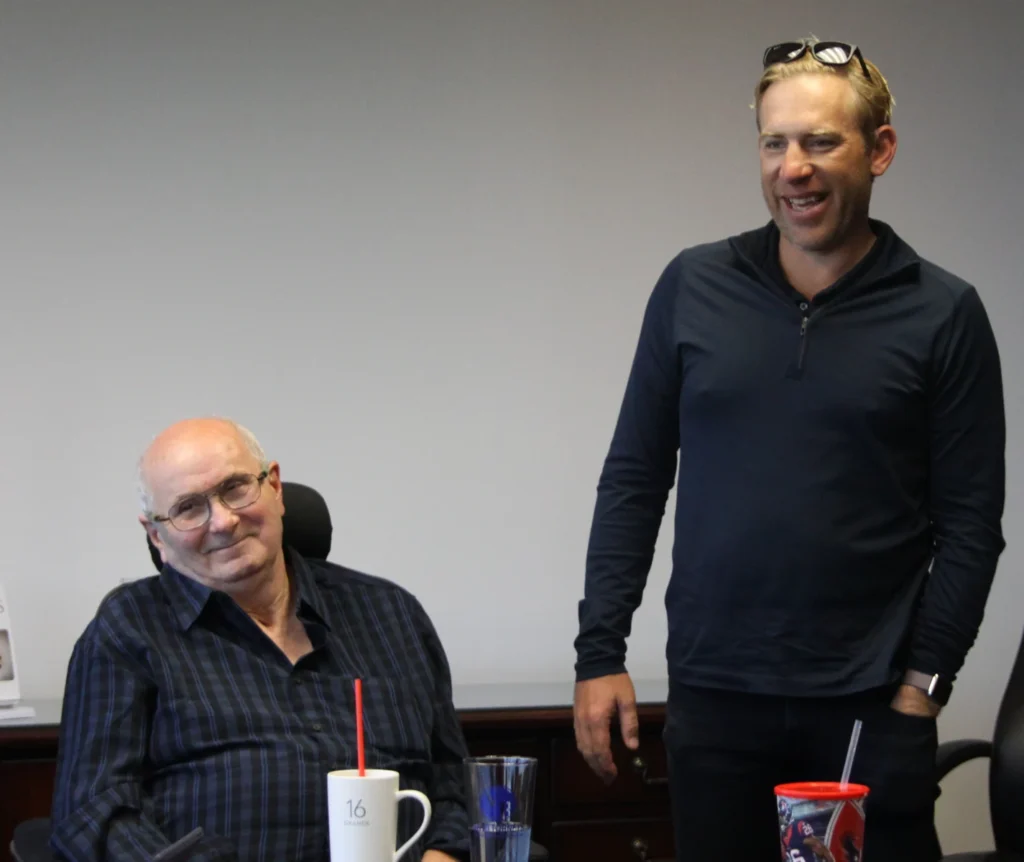
Odis smiles beside Brian Beckcom.
Odis Armstrong discusses his experience with VB Attorneys. Published May 30, 2017 · 1 minute 47 seconds. Watch Odis’s testimonial on YouTube.
Read the previously published transcript
Previously published by VB Attorneys.
Odis: "Yeah - I really appreciate everything y’all have done. Brian, everybody. They’ve helped me out a lot and took care of me and everything."
Brian: "So, Odis, one of the things we like to do at the end of these cases , uh, is kind of ask whether you have any advice, having gone through the lawsuit process and kind of seeing what happens. If you have any advice for anybody that might be looking at going through a similar situation as yours."
Odis: "Hmm. Well, you know, I’d give them advice to contact y’all. That y’all are good lawyers, you know. That’s - I mean, I’ve had a lot of questions myself you know to ask about things and stuff that I couldn’t answer by myself if it wouldn’t be for y’all, you know. So I’d recommend ‘em, you know, to, as one of the things you know, to talk to y’all about it but - uh - the thing that I’ve got, that botulism stuff, is real rare. And I don’t know what to tell people other that just watch what they eat you know about that. Because I’ve been through a lot of stuff, you know that, and I wouldn’t wish this stuff on anybody."
Brian: "Thank you again for - for - letting Lena and I represent you."
Odis: "Well, thank you and Lena both, all of you, for helping me get through all this stuff. Y’all have helped me out a lot."
Brian: "You happy?"
Odis: "Yeah, I’m happy."
Brian: "Good. I’m happy for you. Good to see you, buddy."
What the evidence showed
Every fact below came from the company’s own witnesses and records — and the public health record.
- Health departments in four states and the CDC confirmed no other botulism case in the region — isolating the vessel’s galley as the source.
- A pre-boarding physical three days earlier showed him healthy.
- The company had food-safety training videos; its galley followed none of them.
- Cell-phone records showed the crewman who drove him off the boat never called to check on him.
- The company’s own injury-review paperwork documented the response, step by missing step.
The offer, and the answer
At mediation in January 2017 — with trial set for March — the company’s last firm offer was $6 million. It moved to $7 million a week later, then $7.75 million. The answer stayed the same: the number had to fund the rest of his life, not part of it. In March 2017 the case resolved for $10 Million — believed to be among the largest recoveries the company has ever paid — structured to guarantee his care and his family’s security for life. Brian Beckcom led the case, with Vuk Vujasinovic.
Four million dollars is the difference between a settlement that sounds large and one that actually funds a lifetime of round-the-clock care. We don’t price cases on the company’s math.
More from the record
Every case is different. Prior results depend on the facts of the individual case and do not guarantee a similar outcome.