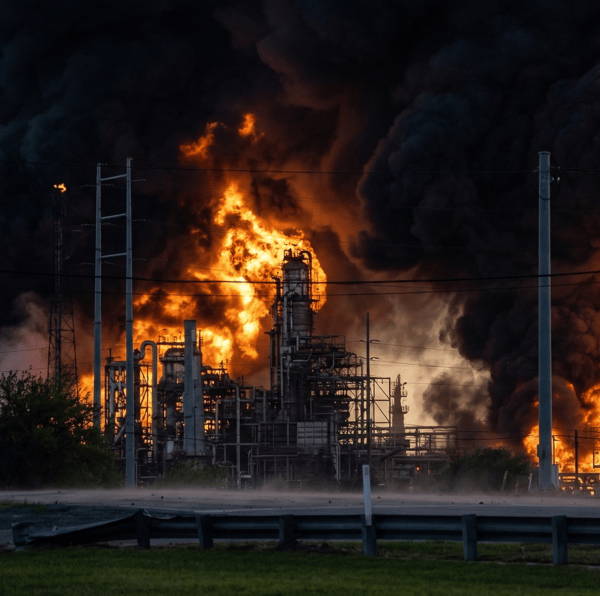
An explosion and fire at Valero’s Port Arthur refinery on Monday, March 23, 2026, sent a large plume of smoke into the air and prompted local officials to order a shelter-in-place for parts of Port Arthur, including areas west of Stilwell Boulevard, south of Highway 73, and the Sabine Pass and Pleasure Island areas.
Our firm represents workers and families in serious industrial accident cases across Texas, including refinery explosions and chemical exposure incidents.
As of early Tuesday morning, officials reported the major fire was out and the shelter-in-place order was lifted. Officials reported no injuries at the time of their initial updates and stated that air monitoring performed by Valero and government agencies did not indicate exceedances of safe thresholds at that point.
What happened at the Port Arthur refinery
Local reporting described the incident as a fire and explosion involving a heater unit, with residents reporting that the blast was felt miles away. County leadership stated that the cause would be better understood in the coming weeks and that an after-action review was planned.
The City of Port Arthur issued an emergency shelter-in-place alert as the response unfolded. National reporting described the event as a large explosion at the refinery that forced nearby residents to shelter in place until the situation stabilized.
Why this matters for workers and nearby residents
Industrial explosions and fires can create multiple injury risks, including traumatic injuries near the blast and respiratory irritation from smoke or airborne particles. CDC guidance on explosions and blast injuries describes how blast waves and associated trauma can cause serious medical issues, and public health guidance on smoke exposure lists respiratory and irritation symptoms that can occur quickly.
Even when officials report that air monitoring did not show exceedances at a specific time, people who experience symptoms should take them seriously and consider seeking medical evaluation. CDC guidance for chemical emergencies also explains shelter-in-place as a protective action and provides practical steps for reducing exposure when instructed by local officials.
In many cases, people do not realize they were affected until hours or days later. That is especially true for respiratory symptoms and chemical exposure, which may not appear immediately after the incident.
Legal rights after a refinery explosion
In Texas, the path to compensation depends heavily on whether the injured person is a refinery employee, a contractor, or a nearby resident or business owner. Texas also differs from most states because most private employers are not required to carry workers’ compensation insurance.
Depending on the facts, claims after an industrial explosion can involve multiple potentially responsible parties, including employers, contractors, and equipment or service companies. In any serious injury case, the timeline matters. Texas Civil Practice and Remedies Code § 16.003 sets a two-year limitations period for many personal injury and property damage claims.
If you were hurt at a refinery, plant, or industrial job site, you may have options beyond what the company tells you. It may help to speak with our work injury lawyers before signing paperwork or giving a recorded statement.
What to document if you believe you were affected
If you were working at the site or in the shelter-in-place area and you believe you were injured or exposed, the most important steps are medical documentation and evidence preservation. Keep copies of medical records, discharge papers, prescriptions, and receipts, and write down the timeline of symptoms as soon as possible.
If you have photos or videos, save the original files. If you missed work, save pay stubs and attendance records. If officials release air-monitoring summaries later, save those too. Local reporting indicates that officials expect more information about the cause in the coming weeks.
The details described above are based on publicly reported information and official alerts. The situation remains subject to review and investigation by relevant agencies and authorities.
Frequently Asked Questions
What should I do if I was near the smoke and feel sick?
If you have symptoms such as coughing, wheezing, trouble breathing, chest pain, or severe headaches, consider seeking medical evaluation and document when symptoms started. CDC guidance notes that smoke exposure can cause immediate respiratory and irritation symptoms, and people with underlying lung or heart disease may be more sensitive.
What if officials say there were “no injuries,” but I was hurt?
Early official statements often reflect what is known at the time. If you were injured or developed symptoms later, the key is to get medical documentation and preserve evidence (photos, records, and timelines) so your situation can be evaluated on its own facts.
How long do I have to bring a Texas injury or property claim?
Many Texas personal injury and property damage claims have a two-year limitations period under Texas Civil Practice and Remedies Code § 16.003. Deadlines can be complicated in real cases, so it is important to get specific legal advice tailored to your situation.
Start a Case
If you were injured at the refinery, while responding to the incident, or while sheltering in place nearby, you can contact our attorneys to discuss your situation.
Call (877) 724-7800 for a confidential consultation, or submit a message through our contact form.
There is no fee unless we win your case.


.svg)