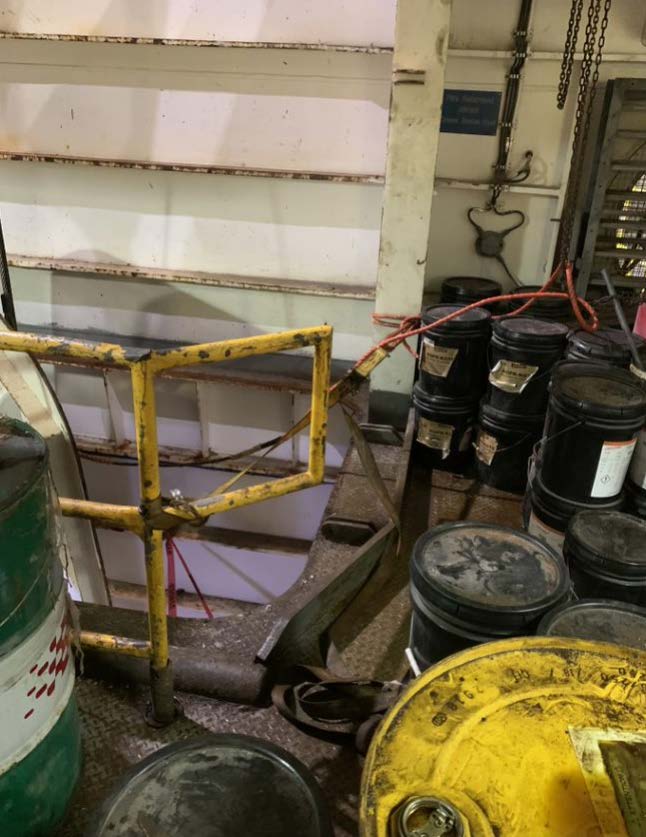
A ratchet strap stretched across the area where the crew needed a substantial barrier. The workers also lacked the fall protection that the job required. When the rig operator investigated, its own root-cause analysis identified failures in planning, permits, procedures and protection against a fall.
Brian Beckcom and Brendan Fradkin represented Jerimick in claims against his employer, Prime Ocean, and the rig’s owner and operator, Valaris. Their work traced the failures in the company’s investigation, tested its witnesses’ explanations and challenged an effort to place responsibility on Jerimick. The case ended in a confidential settlement. Brian holds Board Certification in Personal Injury Trial Law from the Texas Board of Legal Specialization, a distinction held by less than 1% of Texas lawyers.
Preparing an idle rig for work
Prime Ocean assigned Jerimick to work aboard the rig as a roustabout while the crew prepared it to return to drilling. The work involved bringing a stacked rig back into service, a process that required crews to handle equipment and perform tasks around openings between deck levels.
A senior crane operator directed Jerimick to help attach a hatch cover to its hinges. The assignment placed him beside an opening with a substantial drop to the level below. A permanent handrail did not protect that location during the operation.
The crew had stretched a ratchet strap across the area, roughly two feet above the deck. The strap did not provide the protection of a rigid barrier. The crew also proceeded without personal fall protection.
As the crew placed the hatch cover, it rotated through the opening. Jerimick fell to the deck below. The injury required evacuation from the rig and medical care. His wrist injury became a central part of the case, alongside other injuries from the fall.
The company’s investigation identified six failures
Valaris conducted a root-cause analysis after the incident. Brian questioned the people who participated in that investigation, including an operations superintendent and a health, safety and environmental representative.
The operations superintendent agreed with the investigation’s findings. Brian asked him to explain the six causal factors in language a juror could understand.
First, the job required a permit, and the crew had not obtained it. Second, the crew had not reviewed the specific work instruction for removing the hatch. It had instead used a general deck-lift instruction, the kind of procedure that covered moving a basket or other ordinary load around a deck.
Third, the ratchet strap could not provide a proper barrier against a fall through the opening. The superintendent explained the difference between the flexible strap and a rigid piece of steel pipe. The company’s safety requirements called for more than the arrangement the crew had used.
Fourth, the hatch lacked the appropriate lifting points for a vertical crane lift. The existing attachment points served other purposes, including securing the hatch vertically or raising and lowering it while it remained on its hinge. The investigation questioned their use in the operation that injured Jerimick.
Fifth, the crew included short-service employees. The superintendent explained that the company used that term for workers with less than six months of experience, including experience on a particular rig. That lack of familiarity increased the risks of the assignment.
Sixth, the job-safety discussion failed to address the danger of working at height. The crew discussed oil on the deck and the ratchet strap, but it did not identify the fall protection the job required. Workers then performed the task without that protection.
Turning technical findings into a clear account
Brian’s questioning connected the company’s technical language to the conditions around Jerimick. The issue involved a heavy hatch, an opening between deck levels and the people working beside it.
The operations superintendent acknowledged that the task required a working-at-height discussion and protective measures before the crew began. He also identified the crane operator’s responsibility for conducting the job-safety analysis.
Brian asked about the ratchet strap: who had installed it, when and why. The witnesses could not identify its installer. He also questioned the company’s safety representative about the lack of a rigid barrier and fall protection.
This testimony gave Brian and Brendan a detailed account of the safety systems that should have governed the work. The company already had a permit process, task-specific instructions and requirements for working at height. The case examined why those protections did not reach the crew performing the job.
The defense blamed Jerimick for failing to stop the work
The company’s acceptance of the investigation’s findings did not end the dispute. Its operations superintendent still placed blame on Jerimick. He said Jerimick should have recognized the fall hazard, used protective equipment and exercised his authority to stop the job.
Brian followed those answers through the chain of responsibility. He asked whether the same criticisms applied to the other workers and the crane operator. He also asked whether management bore responsibility. The witness acknowledged a management role and explained that the crane operator’s responsibilities included the work instruction and preparation for the job.
That exchange addressed the central tension in the defense. The company expected an individual roustabout to stop an operation that its own planning and supervisory systems had allowed to proceed. Brian and Brendan developed the evidence concerning the permit, the wrong procedure, the missing protection and the experience of the crew to answer that position.
The case also involved two companies with different roles. Prime Ocean employed Jerimick and assigned him to the work. Valaris owned and operated the rig and directed the hatch operation. Brian and Brendan pursued the responsibilities of both companies rather than allowing the division between employer and operator to leave the safety failures unexplained.
Establishing the sequence of the fall
The parties also disputed aspects of Jerimick’s injuries and the events at the opening. The defense challenged his account of a head injury and loss of consciousness.
Brian and Brendan pursued eyewitness evidence. In a later witness examination, a crew member described the hatch cover striking Jerimick in the head, knocking off his hard hat and sending him toward the deck below. That account helped explain the violent movement that preceded the fall, beyond a description of someone simply losing his footing.
Brian and Brendan also prepared a response to Prime Ocean’s request for summary judgment. Their factual presentation connected the employer’s assignment of Jerimick to the work with the rig operator’s own findings about planning, experience and fall protection. The work kept attention on the companies’ responsibilities as the case moved toward resolution.
The confidential settlement
Brian and Brendan secured a confidential settlement for Jerimick. Their preparation combined the rig operator’s investigation, questioning of its personnel, eyewitness evidence and the medical issues that followed the fall.
Questions about this case
If you have injuries from a rig opening, a hatch operation or other offshore work, contact Brian Beckcom or Brendan Fradkin at VB Attorneys at (877) 724-7800 to discuss what happened.
Learn more about our maritime injury practice, or read about a separate maritime fall case involving vessel-condition records.
Every case is different. Prior results depend on the facts of the individual case and do not guarantee a similar outcome.