Case at a glance
- Practice: Truck accidents
- Representation: Vuk Vujasinovic and Job Tennant
The truck drove into stopped traffic
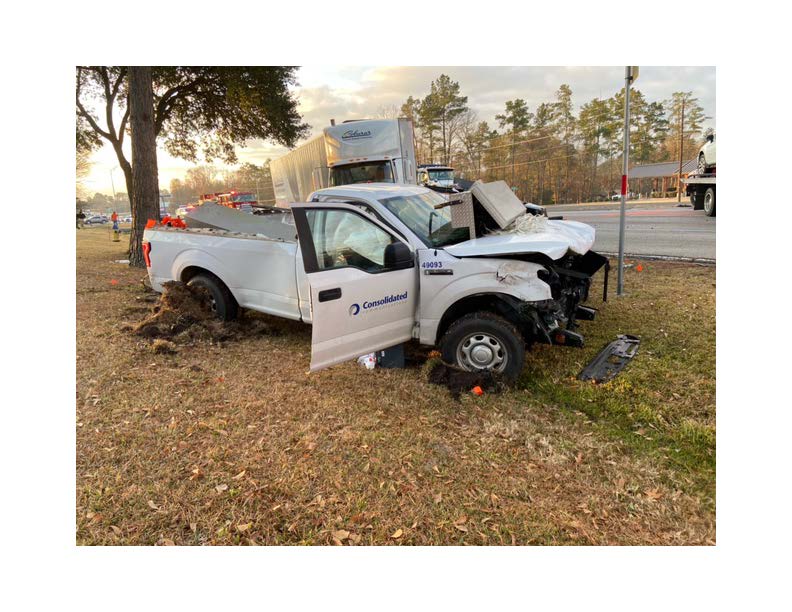
Luis drove a Ford F-150 for his cable-locator job. At an intersection in Lufkin, Texas, he stopped for a red light with other vehicles. A Coburn Supply Company tractor-trailer approached from behind.
Its driver fell asleep at the wheel. The truck struck the waiting vehicles, badly damaged Luis’s pickup and deployed its airbags. The collision left his pickup a total loss. Emergency responders took Luis to the emergency room.
Police and an accident-reconstruction expert supported that Luis wore his seat belt. Even with that protection, he developed lower-back pain that radiated into his legs.
The camera showed what happened
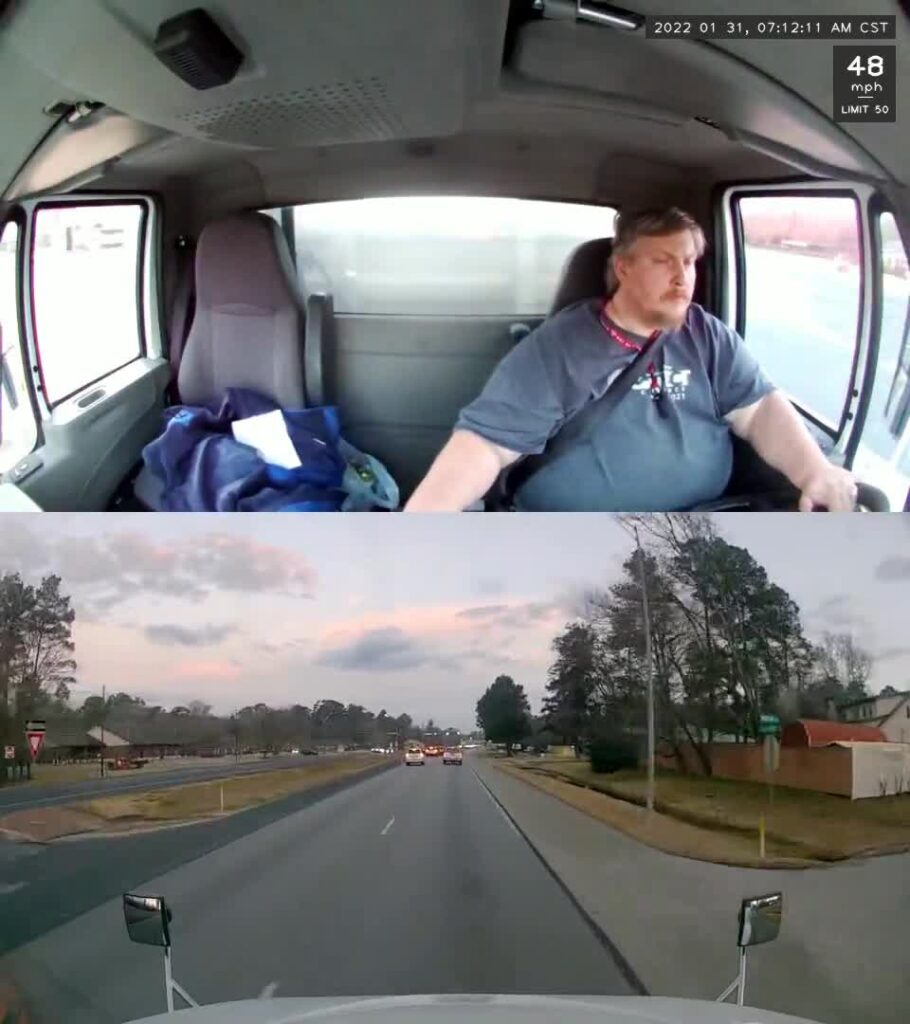
The tractor carried an inward-facing camera. It recorded the driver asleep before and during the collision. The driver told investigators that he had blacked out. He recalled the red light and the cars ahead, but said he had nowhere to go.
Vuk Vujasinovic and Job Tennant used the recording and the police investigation to establish how the crash happened. They also pursued the company’s responsibility for putting this driver on the road.
The company’s director of safety served as its corporate representative on subjects that included the crash investigation. Vuk’s settlement demand cited his acknowledgment that the driver’s falling asleep caused the collision. The demand then traced what Coburn knew about the driver before the crash.
What Coburn knew about its driver
Electronic logs showed that the driver had started duty or driving before 2 a.m. He also had a longstanding history of sleep apnea and a prescription for a continuous positive airway pressure (CPAP) machine.
Vuk and Job examined the company’s knowledge of that condition. Vuk’s demand identified medical documentation that Coburn had received. It also described the driver’s testimony that he had personally told his supervisor about his CPAP machine and explained how he used it.
The driver testified that Coburn gave him no assistance or instruction concerning the condition. He said he would have cooperated if someone at the company had discussed it with him.
The company’s records also raised questions about his driving history. Coburn had previously removed him from driving after he accumulated too many points for driving violations. The demand addressed that history alongside the early-morning route, the sleep-apnea information and gaps in the company’s driver-qualification records.
Vuk and Job pursued the case against Coburn through that evidence of company notice and supervision, as well as the recording of its employee falling asleep at the wheel.
Treatment did not end Luis’s pain
About a month after the crash, an MRI showed injuries to Luis’s lower-back discs. He followed up with a neurosurgeon and underwent physical therapy, steroid injections, medial branch blocks and radiofrequency ablation.
Treatment gave him some relief, but the pain continued to radiate into his legs. His surgeon then performed an endoscopic neurectomy at the bilateral L5 and S1 levels. The operation provided further relief, but Luis continued to experience pain and impairment.
His surgeon identified the possibility of additional surgery and estimated future medical costs. Vuk and Job included that opinion in Luis’s claim, along with his treatment history and continuing symptoms.
He returned to work with limitations
Luis missed work after the crash, then returned to his cable-locator job. He kept working through pain, physical limitations and medical appointments.
Vuk and Job pursued the future losses that his return to work did not erase. A vocational expert evaluated Luis’s prospects and concluded that his injuries put him at risk of reduced advancement, fewer employment opportunities and future earning losses. An economist calculated the potential financial effects.
Vuk’s demand distinguished those future risks from wages Luis had already lost. It also described the demands that his injuries placed on his family. Tasks he once handled himself now caused pain or required help from someone else. Vuk and Job supported that part of his claim with family letters as well as medical and vocational evidence.
Vuk and Job obtained a settlement
Vuk signed the demand that brought together the cab recording, company testimony, driver records, treatment history and future-loss evidence. He and Job obtained a settlement at mediation.
Luis had returned to work, but he still faced pain and the possibility of more surgery. His claim accounted for those continuing losses, not just the damage to his pickup or the workdays he had already missed.
Questions about Luis’s case
Discuss a truck-crash injury
If you or someone in your family suffered injuries in a truck crash, tell us what happened. Contact Vuk Vujasinovic and VB Attorneys for a free consultation.
Explore our truck accident practice or request a free consultation. Call (877) 724-7800.
Every case is different. Prior results depend on the facts of the individual case and do not guarantee a similar outcome.