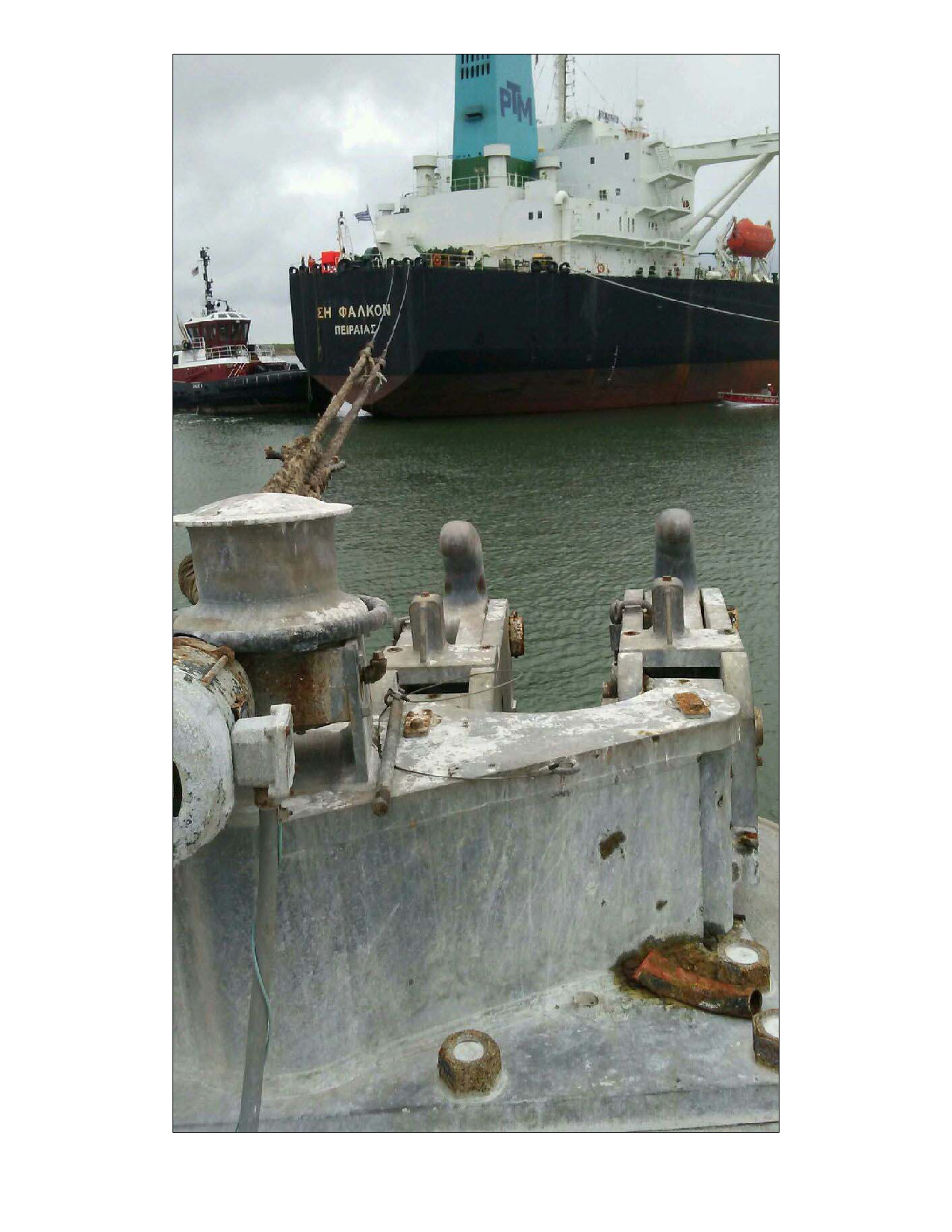
Josh climbed down from the tower and returned to the vessel for help. His crew first took him to an emergency clinic that had closed. He ultimately reached a hospital in Corpus Christi, where a surgeon operated that day.
The injury began a course of treatment that extended far beyond setting a broken bone. Josh needed additional procedures, hand therapy and treatment for complex regional pain syndrome. Brian Beckcom pursued his claims against his employer and the company responsible for the mooring equipment. Josh resolved his case through a settlement. Brian holds Board Certification in Personal Injury Trial Law from the Texas Board of Legal Specialization, a distinction held by less than 1% of Texas lawyers.
A new worker and a jammed mechanism
Line handlers secure vessels to shore and release their lines when the vessels leave. Josh’s assignment required him to work with the hooks that held the tanker’s mooring lines at a waterfront station. His employer had hired him as a greenhand, an inexperienced worker learning the job.
Josh reported that the company had not given him proper training. He worked at the tower without the supervision he needed. The hook had jammed, and he tried to free it. His lawsuit described rust and disrepair in the mechanism and alleged that a steel rod recoiled during the effort to release the line.
That sequence directed the investigation toward both the equipment and the assignment. The employer controlled Josh’s work, training and supervision. A separate company owned or operated the mooring equipment and bore responsibility for maintaining it. Brian pursued both sides of that problem.
Brian filed claims under the Jones Act against the employer and negligence claims against the company responsible for the mooring station. The case addressed what each company knew, what each company controlled and what each company had failed to do before Josh reached the tower.
The company’s own instructions required inspections and training
The employer’s general safety instructions described specific responsibilities for supervisors and boat captains. They required a captain arriving at a dock to inspect bollards, mooring bits and other structures that would bear the strain of a line. They directed workers to report defects and required supervisors to notify the terminal or vessel about unsafe conditions.
The instructions also addressed inexperienced workers. They prohibited employees from using tools or equipment without the necessary training, experience and proficiency. They allowed a worker who lacked those qualifications to perform limited tasks under an experienced, qualified person’s direction.
Those provisions gave the lawyers a concrete way to examine Josh’s assignment. The questions concerned the training he actually received, the supervision at the mooring station and the inspections that preceded the work. A written instruction could describe the correct procedure; the investigation still had to establish whether the companies followed it.
The investigation identified prior warnings about problems with the hooks and lines. Inspection records also identified defective or nonoperational hooks. Josh did not know about those earlier problems when he attempted to release the line.
The lawsuit challenged the maintenance response directly. It alleged that the responsible company had failed to replace old, rusted hooks despite requests and had relied on greasing malfunctioning equipment instead. These allegations focused the case on the condition of the mechanism before Josh’s injury and the opportunities to address it.
Following the warnings through discovery
Brian pursued records about warnings at the mooring towers. The written discovery requested documents and communications concerning warning labels, signs and stickers on the equipment. Brian also requested materials concerning the absence of warnings and any warnings that the company added after the injury.
The lawyers sought answers about pinch-point warnings near the hooks and about the procedure for reporting equipment problems. They asked whether the line-handling company’s supervisors should contact the mooring-station operator when they encountered a problem.
That work examined the information that should have traveled between the two companies. It also addressed what a new worker could learn at the equipment itself. Josh’s experience could not supply the maintenance history, and a warning hidden in a company’s records could not help him recognize a hazard at the tower.
Surgery repaired the fracture, but pain and stiffness continued
At the hospital, imaging showed an open fracture of Josh’s fourth metacarpal, the hand bone associated with the ring finger. The surgeon reduced the fracture and inserted pins to hold the bone in position. Follow-up visits documented swelling, stiffness and restricted movement.
The surgeon removed one pin during an office visit and later removed the remaining pin with imaging guidance. Josh still could not make a complete fist. His hand remained swollen, and his fingers did not move normally.
A hand specialist recommended therapy to restore movement. The therapy evaluation documented reduced grip strength, hypersensitivity and swelling. Treatment included exercises, manual therapy and work at home. Despite that treatment, Josh continued to experience severe stiffness and pain in his ring finger.
He eventually underwent another operation to release tight tissues around the finger and free the tendon. The procedure led to another course of therapy. The persistence of his symptoms made the injury a continuing problem in his daily life, rather than a fracture that ended with removal of the pins.
Treatment for complex regional pain syndrome
A pain-management physician evaluated Josh after the hand pain continued. He reported that the pain interfered with sleep, work and everyday activities. The physician documented tenderness, swelling and limited movement and investigated possible complex regional pain syndrome.
Josh subsequently received a series of stellate ganglion blocks as treatment for complex regional pain syndrome in his right upper limb. The injections brought substantial relief at a follow-up visit, but he still experienced stiffness, altered sensation and restricted movement.
His physician discussed continued therapy and pain management if the pain flared again. The treatment plan also identified a spinal cord stimulator as a possible next step if the blocks failed to provide adequate relief. Josh’s future care therefore required attention alongside the operations and therapy he had already undergone.
The settlement
Brian developed a case that connected the work assignment, the condition of the mooring equipment and Josh’s continuing medical needs. Josh resolved his case through a settlement.
Questions about this case
If you have injuries from line handling, mooring equipment or other maritime work, contact Brian Beckcom at VB Attorneys at (877) 724-7800 to discuss what happened.
Learn more about our maritime injury practice, or read about another maritime machinery case involving a crush injury.
Every case is different. Prior results depend on the facts of the individual case and do not guarantee a similar outcome.